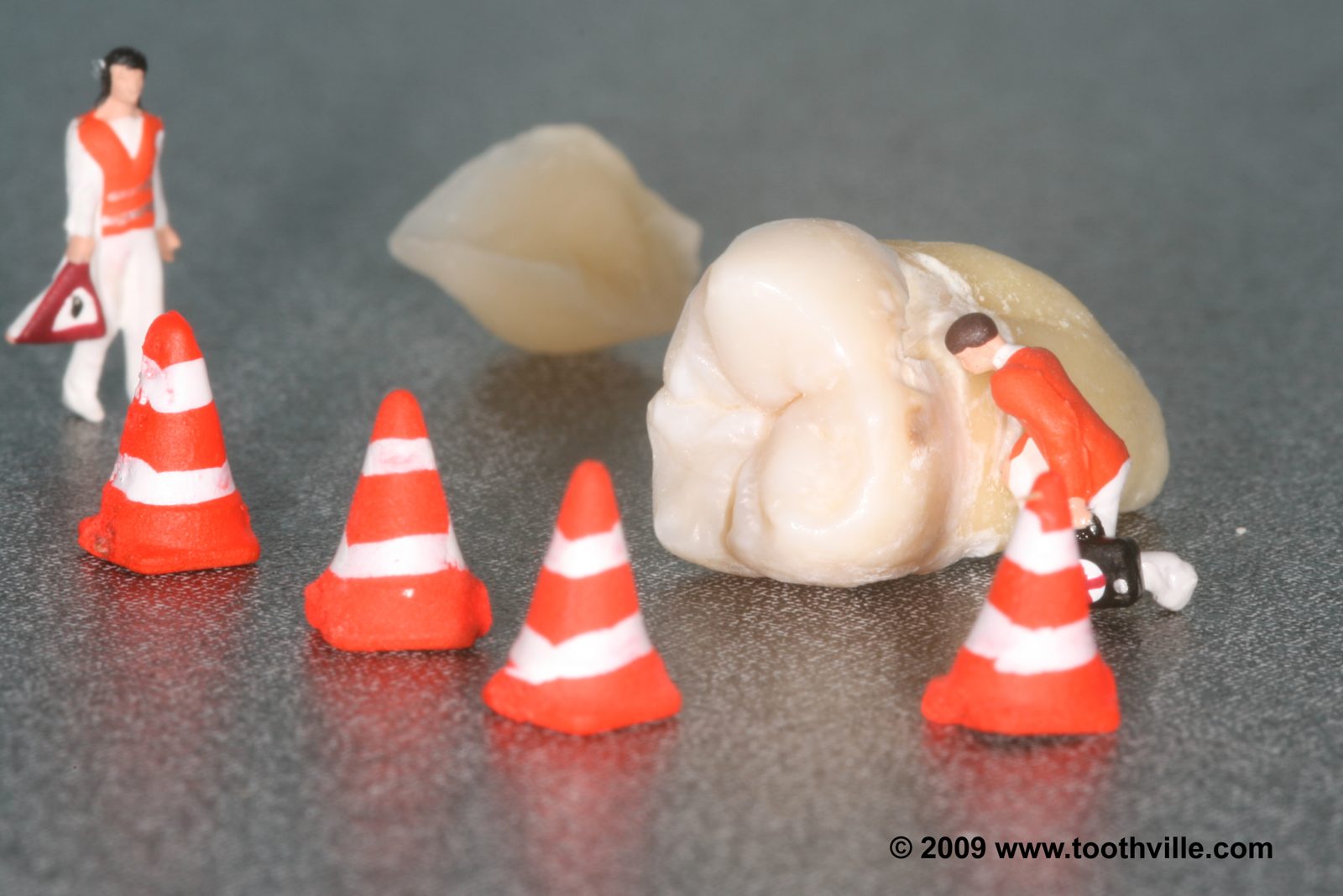
If you stop and think about it for a moment, your body is remarkable at fixing itself. Cut your skin and it knits back together. Break a bone — even badly — and over a few weeks it will heal so well that, on an x-ray years later, you often can’t tell where the break was. Hair, nails, the lining of your gut, the muscles in your shoulder — they all repair, regenerate, or remodel themselves.
Teeth don’t.
Of all the structures in your body, your teeth are the one that, once damaged, simply do not put themselves back together. If you snap the corner off your front tooth and walk into my surgery holding the broken fragment in your hand, I can show you something curious: even if you held that piece against the tooth for ten years, it would never reattach. There’s no biological mechanism for it. The two surfaces would not knit. It just doesn’t happen.
I genuinely think this is the most important fact in dentistry, and most patients have never had it explained to them properly. So let me try.
I sometimes describe it to patients as a ‘design fault’. Bone — the structure people most often assume is similar to a tooth — heals almost completely. Hair and nails grow back. Even cartilage, slow as it is, has some repair capacity. Teeth alone are the one structure where damage is permanent, and where any tissue you lose, you lose for good.
The implication of this single fact is huge, and it ought to inform almost every decision a dentist or a patient makes about treatment. Because if a tooth can’t repair itself, two things follow.
The first is that prevention matters more for teeth than for almost anything else in the body. If you sprain an ankle, you can be a little less careful next time because the ankle will heal. If you lose a piece of enamel, that’s it. The piece is gone. The most important thing you can do for your teeth, by a long way, is not damage them in the first place.
The second is that every time we do remove something from a tooth, we should remove the absolute minimum we can. Because we are taking away tissue that, once gone, can never be replaced by your body. We can put something in its place — a filling, a piece of porcelain, a crown — but a restoration is never quite the same as the original tooth. The original is always stronger, always better integrated, always the gold standard.
These are not abstract principles. They drive how I think every single time I pick up a drill.
There’s an old line in our profession: the best dentistry is no dentistry. The minute you accept the design fault, the line becomes a serious clinical principle. If a tooth doesn’t strictly need to be touched, leaving it alone, as it is, is a meaningful clinical choice. It’s not laziness. It’s not avoiding work. It’s an active decision based on what we know about how teeth behave.
The corollary follows almost automatically. If treatment is needed, make it as small as possible. Keep as much of the natural tooth as you can. Choose the option that removes the least tissue. Use techniques that bond onto what’s already there rather than techniques that require you to grind away healthy structure to create room for a new restoration.
That whole philosophy — small, conservative, additive rather than subtractive — flows from the simple observation that teeth don’t heal.
There’s a question I get from patients all the time. Usually after I’ve just finished a filling, or fitted a crown, or done some restorative work. The patient looks at me and asks:
Is the filling strong enough?
Or sometimes:
Is the crown going to be strong enough?
I understand the question. People want reassurance. They want to know that the work I’ve just done is going to hold up. But the question is, in an important sense, the wrong one. Because a filling or a crown, considered on its own, is almost always strong. The bigger question — the one that determines whether the tooth will actually last — is different.
Is my tooth strong enough?
A crown sitting in your hand, in one piece, is not very helpful to anybody. It has to be in your mouth, fixed to a foundation, doing a job. And the foundation is your tooth. If we’ve had to remove a lot of tooth tissue to fit that crown — grinding down the walls of the tooth to a small stump — the crown might be perfect, but the foundation underneath it is now weak. And no restoration is stronger than the tooth it sits on.
I see this play out in the chair on a regular basis. A patient comes in with a problem and we discover that a beautifully made crown has come loose, not because the crown failed, but because the tooth has actually fractured beneath it. The crown is fine. It’s the root that’s broken. And once that happens, the tooth is usually gone — extraction, then implant, or a bridge, or something more involved is required.
Why did the tooth fracture? Almost always, because there wasn’t enough of it left. The foundation had been thinned too much in the original preparation, often years earlier. The work itself was good. But the foundation underneath wasn’t strong enough to support it indefinitely.
Everything is only as good as its weakest link. In dentistry, the weakest link is very often the tooth.
This is also why dentistry has what people sometimes call a slippery slope. Every intervention slightly compromises the tooth. A small filling, well done, isn’t really a problem — the tooth still has plenty of structure left to work with. But each subsequent intervention removes a little more. A small filling becomes a slightly bigger one. The bigger one becomes a still bigger one. At some point, the remaining structure isn’t enough to support a normal filling, and we move to an onlay or a crown, which involves removing more tissue still. If the nerve gets inflamed along the way, you may need a root canal, which weakens the tooth further. And so on.
This is a real phenomenon, and it’s well documented. If you’ve had dentistry done, you’re more likely to need more dentistry. That isn’t because dentists are doing a bad job. It’s because once you’ve started intervening on a tooth, the foundation is slightly compromised each time. The slope isn’t steep — for many teeth, the cycle can take decades — but it’s real, and it should affect how we think about that first decision to drill.
This is the case for being slow to start. Once you’ve stepped onto that slope, you cannot fully step off it. The question I always come back to is, do we have to intervene at all yet, or is there a way to hold this where it is? Sometimes the answer is yes, we have to act. Often, with good prevention, the answer is not yet. Sometimes, with very good prevention, the answer is not ever.
Practically, the things to take away from this article are:
Your teeth do not repair themselves. They are different in this respect from almost every other part of your body. This is a fact you should plan around.
Whatever you can do to prevent damage — daily oral hygiene, sensible diet, regular check-ups — is more valuable than any restoration could be. The original tooth is always better than the best replacement.
When something does need doing, the conservative option — the one that removes the least tooth — is almost always the right one. If a dentist suggests an intervention that requires extensive removal of healthy tissue for primarily cosmetic reasons, that is a moment to slow down and ask whether there’s a more conservative way.
And if you’re about to be told that your restoration is “strong enough,” it’s worth gently turning the question around: is my tooth strong enough underneath it? That’s the question that determines how long the work will really last.
In the next piece I’ll get into specific techniques — particularly crowns versus onlays, and the case for and against veneers. There are real choices in conservative dentistry, and most patients have never been walked through them properly. That’s part three.
Dr Ian Davis is a partner at BDS Dental. To book a check-up or talk through restorative options, contact the practice here.
Our reception team is happy to help with bookings, treatment enquiries, and new patient registrations. Get in touch today and we will find a time that works for you.
We have more than 100 five-star Google reviews from patients across Golders Green, Hampstead, and North London. Read what they have to say, or book an appointment to experience the care for yourself.
I've been going here for over 40 years so I think I'm well placed to give an honest review. From the minute you walk in, you're greeted in reception by Eli Sheva or Bridget. They are both courteous a... Read More
As always Ian was fantastic his kindness and professionalism makes it a pleasure to attend the Surgery. I am grateful to have such an incredible Dentist.
I am a patient of Dr Nina Kosarevic - she is a fantastic dentist and aesthetic medicine clinician. I have recently started seeing her for concerns regarding forehead lines and we discussed options in ... Read More
I had the pleasure of seeing Nina today at Bergin Davis Sidelsky Dental Practice. She is incredibly professional and attentive to detail — she simply wouldn’t let me leave until she had thoroughly... Read More
I travelled from East London to Golders Green as I was informed by multiple people that Dr Nina is a brilliant dentist. I had a chipped tooth and at 7 months pregnant my options were limited. Dr Nina ... Read More